Villum Experiment
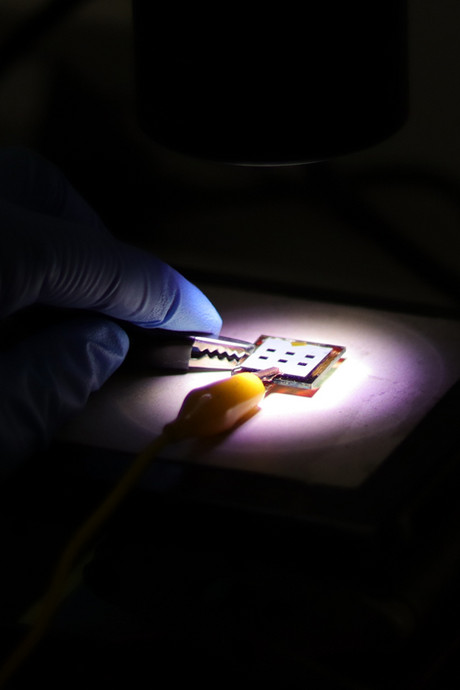
Perovskite solar cell stabilization via tuned ion and charge transport kinetics at new metal oxide/perovskite interfaces (2022)
Granted amount:
DKK 2.0m

Ready to take a chance?
With the Villum Experiment Programme Villum Foundation is ready to take a chance and support unconventional and risky ideas that challenge the norm. The ideas might hold, e.g., the potential to answer a long-standing question in science, bring a transformative understanding of a central topic, nurture a fruitful new research area or create the foundation of a novel method or technology.
In traditional funding schemes, grant proposals are evaluated by review panels which judge the merits of both the scientific idea and the applicant. Typically, such review panels make their decisions by consensus. While this procedure is time-tested and widely used, it may exclude a certain class of breakthrough ideas that can seem unripe, too risky or even naive at first glance. The Villum Experiment Programme is designed for exactly those ideas.
An amount of DKK 125 million is allocated to this call.
Anonymous evaluation
A key characteristic of the Villum Experiment Programme is its anonymous evaluation process, allowing the review panel to focus solely on the originality and potential of the idea. This ensures that bold and unconventional research proposals have a fair chance regardless of the researcher’s background. The application and evaluation processes underpin ideas in their early phase and aim to facilitate unconventional thinking.
Two-stage application procedure
The Villum Experiment scheme is very popular in the research community. While the foundation is pleased that this is so, the large number of applications we receive every year raises a number of issues that need to be addressed. If the success rate (i.e. the number of grants divided by the number of applications) becomes too small, the resources of the research community are not spent well. In addition, the quality of the selection process may be compromised when the number of applications that the individual members of the assessment panel have to read becomes excessively high.
For these reasons Villum Foundation has introduced a demand management procedure for the Experiment call. The call will be conducted in two stages:
Villum Foundation is committed to a constructive dialogue with the research community about demand management. We expect you only to submit an expression of interest if you have a bona fide research idea. The same research idea may not be submitted by several researchers in the same research group. In general, we trust that researchers will not try to ‘game’ the process.
Definition of technical and natural sciences
Villum Foundation supports technical and natural sciences embedded in Danish universities and research institutions. The research can be curiosity-driven or aiming at societal challenges. In all cases, it must have a clear scientific objective.
In relation to ERC’s evaluation panels Villum Foundation supports as a rule ”Physical Sciences and Engineering” (PE1-PE10) and parts of “Life Sciences” (LS1-LS3, LS8). Cases may occur where the research falls partly outside the categories.
Health or veterinary research, i.e. research focused on the health of humans and animals, including nutrition, medicine, biomedicine, pharmacology and research within diagnostics and methods for examination and treatment.
Furthermore, applicants affiliated with departments whose main scientific focus is within these areas (including university health departments, hospitals, the Danish Cancer Society, DTU Health Tech and SDU Health Informatics and Technology) are not eligible to apply and will receive an administrative rejection.
Projects with a commercial focus are not supported.
The expression of interest consists of a project title, an abstract of max. 1000 characters, and information about the applicant. The title and abstract should describe the project idea in broad terms.
You also need to confirm that you are the only one submitting this idea to the call and that your host institution is aware of your expression of interest and will host your project if granted. The confirmations are done through check boxes; no documents need to be supplied for the expression of interest.
After the deadline for submitting an expression of interest has passed, the foundation will conduct a lottery for 300 application tickets in early January, and you will be informed of the result shortly thereafter. The process is a pure lottery and the scientific merits of the idea will not be assessed in any way at this stage.
If you win a ticket, you may submit a full application as outlined below. The application should be on the same idea you submitted in the expression of interest. However, both title and abstract may be adjusted if needed.
You will only be allowed to submit an application if you have submitted an expression of interest and it has been selected by lot to proceed (see above).
The full proposals are pre-screened by Villum Foundation’s secretariat and the working group for technical and natural science to check that they comply with the eligibility conditions stated above. The anonymous proposals which pass the pre-screening are distributed among the four scientific review sub-panels according to the proposal’s research area. The terms of reference of the panel can be found below along with the review sheet and an overview of the assessment and selection process. The panel members do not see the CVs or support letters and do not know the identities of the applicants.
To increase diversity and respect the uniqueness of outliers, each panel member is provided with a decisive vote which they can use only once. The panel member has the option to cast the decisive vote for an application which they find to be particularly promising/valuable and therefore deserves the highest priority.
The reviewers pass their evaluations on to the foundation and the applications are ranked according to their scores, taking the decisive votes into account.
As a final step, the CVs of the highest ranking applications are screened by Villum Foundation’s working group for technical and natural science and the foundation’s secretariat. The screening team checks the researcher's level of expertise within the area of the proposed project. The panel’s ranking is maintained, but applications that fail the screening test are disqualified. A final list of fundable applications is recommended to the board who makes the grant decision.
Note: In previous rounds of funding, all applicants put forward by the review panel passed the final screening process.
The application must contain the following four documents:
The documents above must be submitted as four separate pdf files. To preserve anonymity, it is important that you remove all personal information from the file names and metadata of the proposal and the budget. The CV and the support letter will not be seen by the Experiment panel and should (of course) include the name of the applicant. Any additional documents submitted will not be taken into consideration.
A Villum Experiment grant cannot be used to cover the salary, in full or in part, of assistant professors, associate professors or professors (or equivalent positions such as researchers or senior researchers). This is true whether or not they are permanently employed at the host institution.
If you apply for your own salary as a postdoc, you need to consider whether you will be legally able to remain in a postdoc position for the full 2-year project period. This depends on your employment history at your host institution and possibly other Danish research institutions. You may only apply for your own salary for the part of the project period in which you are a postdoc. In this case, the host institution needs to commit to covering the rest of your salary. This you need to confirm at the time of submission of the expression of interest.
Villum Foundation received 1113 eligible expressions of interest by the end of the deadline, 6 January 2026. The lottery for the 300 application tickets was conducted using the SHA-256 (256 bit Secure Hash Algorithm) to generate a (pseudo-)random sequence based on the titles of the expressions of interest.
This is done by initiating the algorithm with a ‘salt’ calculated as the output of SHA-256 on the text string obtained by concatenating all the titles of the 1113 expressions of interest in the order in which they were created: salt = SHA-256(title1 || title2 || ... || title1113). The salt obtained in this way is:
salt = 132e5863739041cf38e88cc2f137f425912421aaa9f36fe60e371b927adb439c
For each expression of interest a hash value is calculated as
hash_EoI_i = SHA-256(salt || title_i).
Finally, all hash values are sorted in increasing order and the 300 first values are selected. The corresponding expressions of interest will proceed to the application stage.
In the file below, you can find a list of all 1113 hash values together with their corresponding application ID. If you have submitted an expression of interest, you may find your application ID and verify your order in the list. You may check the calculation of the hash value, using any of the many available implementations of SHA-256 found online, by inputting the salt followed by your project title. The top 300 expressions of interest in the list have proceeded to the application stage. All applicants have received an email with the result of the lottery draw.
Print the necessary guidelines before applying.